by
by One of the strangest things about perimenopause sleep is that it can change even when nothing else about your bedtime routine seems to have changed. You may still go to bed at roughly the same time, fall asleep fairly easily, and feel tired enough to sleep through the night. But then, somewhere around 2 or 3 in the morning, you suddenly wake up. Sometimes you feel a little warm. Sometimes you need to use the bathroom. Sometimes there is no obvious reason at all. You are simply awake, and what makes it even more frustrating is that your brain seems much more alert than it should be at that hour.
If this has started happening to you, you are certainly not the only one. Sleep problems become more common during the menopause transition, and difficulty staying asleep is a common complaint during perimenopause and menopause. The reason is not always as simple as “your hormones are low,” either. Hormone levels can fluctuate considerably during perimenopause, and these changes can occur alongside hot flashes, night sweats, changes in body temperature, mood changes and other factors that can interfere with sleep.
Why Does Perimenopause Sleep Change and Wake You Up at Night?
When we think about menopause and sleep, most people immediately think about night sweats. That makes sense because waking up drenched in sweat is obviously going to interrupt your sleep. But the relationship between sleep and hot flashes can actually be more complicated than that.
Some women notice that they wake up feeling warm but are not necessarily sweating heavily. In some cases, the awakening itself may happen before a noticeable hot flash, rather than the hot flash being the thing that wakes them. Research into menopausal sleep has found that changes in temperature regulation and hot flashes can be closely associated with nighttime awakenings, but the exact sequence can vary from person to person.
This is why it can be confusing when you wake up at 2 or 3 AM and think, “I don’t even have a hot flash. Why am I awake?” It doesn’t necessarily mean that menopause has nothing to do with it. At the same time, it would also be too simplistic to assume that every middle-of-the-night awakening is caused by hormones.
There are many other things that can interrupt sleep. Caffeine later in the day, alcohol, stress, pain, medications, needing to urinate, an uncomfortable bedroom temperature, sleep apnea and restless legs are just some of the possibilities.
This is why paying attention to what actually happens when you wake up can be more useful than simply labeling it “menopause insomnia.”
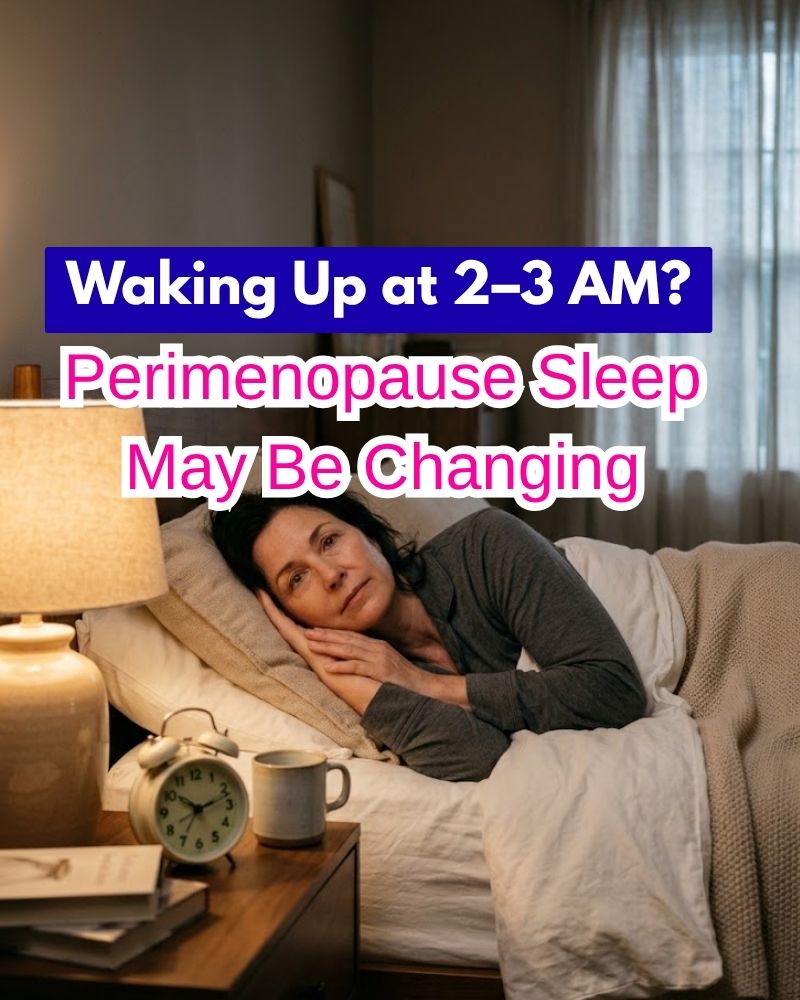
The real problem may be what happens after you wake up
For many women, waking up isn’t necessarily the worst part. The difficult part is trying to fall asleep again.
You may wake up, notice that it is 2:30 AM, and initially feel quite calm. Then you look at the clock again and start calculating. You have to get up at 7. That means you have about four and a half hours left. Then you start thinking about tomorrow, wondering whether you will be tired, whether you will be able to concentrate, and whether this is going to happen again the following night.
Before you know it, you are no longer simply awake. You are worrying about being awake.
That can create a frustrating cycle, especially when you are already dealing with perimenopause sleep changes. The original awakening might have been caused by temperature changes, a noise, the need to use the bathroom, or simply a normal brief awakening between sleep cycles. But once you become anxious about not falling back asleep, your mind becomes more alert, making it even harder to return to sleep.
This is one reason that constantly checking the clock may not be helpful. The National Institute on Aging specifically recommends avoiding clock-watching when you wake during the night. The idea is not that looking at the time is dangerous, but that repeatedly checking the clock can increase frustration and make you more focused on how little sleep you have left.
If you regularly wake at 2 or 3 AM, you could try turning the clock away from the bed and resisting the urge to check it. You don’t need to know exactly how long you have been awake.
How Perimenopause Sleep Is Affected by Your Daytime Habits
It is easy to focus entirely on the moment you wake up, but sleep doesn’t begin when your head touches the pillow. What you do during the day can affect what happens several hours later.
For example, if you are drinking coffee in the late afternoon because you feel tired, you may not notice an immediate problem. You may still fall asleep normally at night. But caffeine can remain in the body for several hours, and some people are particularly sensitive to its effects. If you have recently started waking during the night, moving caffeine earlier in the day is a relatively simple experiment.
The same applies to alcohol. It may make you feel sleepy initially, but it can disrupt sleep later in the night. So if your pattern is “I fall asleep easily but wake up a few hours later,” it is worth looking at what you are drinking in the evening rather than only focusing on your bedtime routine.
Daytime movement can matter too. Regular physical activity is generally associated with better sleep, although exercising very close to bedtime can be stimulating for some people. You don’t necessarily need an intense workout. A reasonable amount of movement during the day is often a more realistic place to start.
And then there is something much more basic: daylight. Getting outside during the day gives your body a stronger light-dark signal, which is one of the cues that helps regulate your circadian rhythm. This doesn’t mean that going outside for ten minutes will magically fix perimenopause insomnia, but maintaining a regular day-night rhythm is part of supporting healthy sleep.
What if you wake up feeling hot?
If you consistently wake up feeling warm, your bedroom environment is worth looking at. This does not mean you need to make the room extremely cold. In fact, becoming too cold can be uncomfortable and may create another reason to wake up.
The goal is simply to make it easier for your body to stay comfortable. Lighter bedding, breathable sleepwear and a bedroom temperature that feels comfortable to you may help, particularly if night sweats or temperature changes are part of your symptoms. The National Institute on Aging also recommends keeping the bedroom cool and comfortable for women experiencing menopause-related sleep problems.
It can also be useful to notice whether the feeling of heat actually happens before you wake or only after you are already awake, especially when you’re trying to understand your perimenopause sleep patterns. If you repeatedly notice that you wake first and then feel warm, that is a different pattern from being woken by a strong hot flash. You don’t need to diagnose yourself from this observation, but it is useful information to remember if you eventually discuss your sleep with a doctor.
What should you do when you are awake at 3 AM?
This is where many people instinctively do the opposite of what helps. They stay in bed and try harder to sleep.
You close your eyes tightly. You tell yourself to relax. You calculate how many hours are left. You become frustrated when another ten or twenty minutes passes.
Unfortunately, sleep isn’t something you can force very easily.
If you are awake but still relaxed, there is nothing wrong with simply staying in bed and allowing yourself to rest. But if you are becoming increasingly frustrated and clearly wide awake, getting out of bed for a short period and doing something quiet in dim light can be more useful. Reading something unexciting, sitting quietly or doing some gentle relaxation can give your brain a chance to settle before you return to bed when you feel sleepy again. This is consistent with the principles used in cognitive behavioral therapy for insomnia, which is one of the established approaches for persistent insomnia.
What I would avoid is turning 3 AM into the beginning of your day. Opening your phone, scrolling through social media, answering messages or reading something particularly interesting can make your brain much more alert. Even if you initially picked up your phone because you were bored, you may end up teaching yourself that waking at 3 AM is a time for stimulation.
Don’t assume every sleep problem in your 40s is menopause
This is probably the most important caveat. Perimenopause is a very reasonable thing to consider when a woman who previously slept well suddenly starts having frequent nighttime awakenings, especially if other menopause symptoms have appeared at the same time. But it is not the only explanation.
Stress, anxiety, medications, pain, urinary problems, alcohol, caffeine, sleep apnea and restless legs can all affect sleep. Some women may also have more than one factor at the same time.
For example, you might have some hormonal changes that make you more sensitive to heat, but you may also be drinking coffee later because you are tired during the day. Or perhaps your knee hurts when you turn over in bed. Or you have started waking to urinate more often. It doesn’t have to be one single cause.
This is why a simple sleep pattern can be surprisingly useful. For a couple of weeks, you could make a note of roughly when you went to bed, when you woke, whether you felt hot or sweaty, caffeine and alcohol intake, exercise and how you felt the next day. You don’t need to track twenty different things. The purpose is simply to see whether there is a pattern.
When Is Perimenopause Sleep a Concern?
Occasional nighttime waking is not automatically a sign that something is wrong. Most people wake briefly during the night from time to time. The bigger concern is when it becomes frequent and starts affecting your daytime life.
If you are regularly awake for long periods during the night, constantly exhausted during the day, struggling to function normally, or experiencing significant snoring, gasping or breathing pauses during sleep, it is worth discussing the problem with a healthcare professional. Persistent insomnia is treatable, and cognitive behavioral therapy for insomnia is one evidence-based treatment option.
For women whose perimenopause sleep problems are closely connected with hot flashes or other menopause symptoms, there are also menopause-specific treatment options that can be discussed with a doctor. That does not mean everyone needs medication, and it certainly doesn’t mean that every woman who wakes at 3 AM needs sleeping pills.
The point is that you have options.
Maybe the first step is simply understanding the pattern
One of the frustrating things about perimenopause is that changes can appear in places you never expected, including your perimenopause sleep. You may have spent years thinking of sleep as something your body simply knew how to do. Then suddenly, you are waking in the middle of the night and wondering what happened.
It can be tempting to search for one simple explanation. Maybe it is cortisol. Maybe it is estrogen. Maybe it is your room temperature. Maybe you need magnesium. The internet has plenty of explanations ready for you.
But real life is usually less tidy than that.
Perimenopause can affect sleep, and hormonal changes may make some women more vulnerable to nighttime awakenings. At the same time, your sleep is influenced by your daily habits, stress, environment, physical symptoms and overall health.
So if you keep waking at 2 or 3 AM, instead of immediately asking, “How do I make myself sleep?” it may be more helpful to ask, “What happens just before and after I wake up?”
Do you feel hot? Are you sweating? Is your mind racing? Do you need the bathroom? Did you drink coffee late? Are you uncomfortable somewhere in your body? Can you fall asleep again easily, or are you lying awake for an hour?
Those details may tell you more than the clock ever will.
And perhaps the most reassuring part is this: having your sleep change during perimenopause does not mean that you are destined to sleep badly forever. It means something has changed, and it is worth understanding what that change looks like before deciding what to do about it.